
Ranthambore Fort History, Timings & Travel Tips (Complete Guide)

Most people who come to Ranthambore come for the tigers, so their planning usually starts with a safari slot and one of the resorts near Ranthambore National Park. The fort often ends up as an afterthought — something you see appearing above the treeline from your safari jeep. That is a mistake. Ranthambore Fort has stood on that 700-foot hill for over a thousand years. It has survived sieges that wiped out entire armies, seen Rajput queens walk into fire rather than surrender, and watched Mughal emperors come and go. Understanding its Ranthambore fort history before you walk inside changes the entire experience.
Ranthambore Fort History — Where It All Begins
The fort's foundation was laid in the mid-10th century (around 944 CE) by early Chauhan rulers and was originally called Ranastambhapura — meaning 'City of the Battle Post’.
Its location on an isolated hill at the junction of the Aravalli and Vindhya ranges was deliberate. The fort controlled primary trade and military routes between North and Central India. Whoever held Ranthambore held the road — making it one of the most fought-over strongholds in medieval Rajputana.
Centuries later, following the fall of Ajmer in 1192 CE, the Chauhan line at Ranthambore was re-established by Govindaraja, son of the legendary Prithviraj Chauhan. Under this branch, the fort grew into a formidable stronghold, leading up to the ruler whose name defines it to this day.
Hammir Dev Chauhan and the Siege of 1301
Hammiradeva (also written as Hammir Dev Chauhan), who ruled from 1283 to July 10, 1301, was the last Chauhan ruler of Ranthambore.
The events that led to the fall began in 1299. When Alauddin Khalji's generals Ulugh Khan and Nusrat Khan were returning to Delhi after a campaign in Gujarat, some Mongol soldiers in their army staged a mutiny. These rebels sought refuge with Hammiradeva. He granted it.
Alauddin Khalji demanded their surrender. Hammiradeva refused. His position, preserved in Rajput oral tradition, was simple: when a Rajput promises protection, he keeps it even with his life. That refusal triggered a war.
1291: Jalaluddin Khalji had tried to take Ranthambore and retreated, finding the fort impregnable. 1299–1300: Alauddin sent Ulugh Khan and Nusrat Khan. They were defeated by Chahamana generals near the fort. 1301: Alauddin came himself. He ordered construction of a massive earthen mound against the walls. The siege was long. Famine hit inside the fort. Two of Hammiradeva's own generals defected to Alauddin. The walls were finally breached.
On July 10, 1301, Hammiradeva led his remaining companions out in a final charge. He died fighting. Inside the fort, his wives, daughters and female relatives performed Jauhar — collective self-immolation rather than capture.
This Jauhar was documented by Amir Khusrau in Khazain-ul-Futuh, making it the first Jauhar in Indian history to be described in a Persian language text. Alauddin captured the fort and appointed Ulugh Khan as its governor.
After the Chauhans — Mughals and Beyond
After Alauddin, the fort passed through several dynasties. The Hada Rajputs of Bundi held it for a period. In 1558, the Mughal Emperor Akbar besieged the fort, this time held by Surjan Hada. Surjan Hada eventually surrendered and was granted the governorship of Benaras in exchange — a negotiated end rather than a bloody one.
The Mughals held Ranthambore until the middle of the 18th century, after which it came under the control of the Jaipur Kachwaha Maharajas, who used the surrounding land as a royal hunting preserve. That hunting preserve eventually became Ranthambore National Park.
UNESCO Designation
In 2013, Ranthambore Fort was inscribed as a UNESCO World Heritage Site as part of the Hill Forts of Rajasthan group — alongside Amber, Jaisalmer, Chittorgarh, Kumbhalgarh, and Gagron. The group designation recognised the forts' collective significance as examples of Rajput military architecture, each reflecting different dynasties and defensive strategies.
For Ranthambore, the UNESCO status is particularly notable because the fort sits entirely within an active tiger reserve — making it one of the very few UNESCO heritage sites in the world accessible only through wildlife territory.
Architecture — What You See Inside
The fort complex is large enough that most casual visitors see only a fraction of it. Here is what to look for:
The Seven Gates (Pols):
Entry into the main fort complex is through a series of seven gates — Ganesh Pol, Hathi Pol, Navlakha Pol, and four others. This layered defence was deliberate: even if attackers broke through one gate, they faced another immediately. Crossing all seven under arrow fire was extraordinarily difficult — which explains why the fort resisted so many sieges for so long.
The Fort Walls:
The fortification walls run for several kilometres around the hilltop, reinforced by massive bastions following the natural contours of the hill.
Palaces, Pavilions and Step Wells:
The royal quarters are now largely in ruins, but stone pavilions (chattris), water tanks (baoris), and step wells survive. These tanks were critical during sieges — the fort had its own water supply independent of external sources.
Red Karauli Stone:
The five temples inside the fort are constructed from distinctive red Karauli sandstone — warm-toned and photogenic, especially in morning light.
The Temples Inside the Fort
The temples are arguably the most visually striking part of the fort today. Five stand within the complex:
Trinetra Ganesh Temple is the most significant. The idol depicts Lord Ganesh with his entire family — wife Riddhi and Siddhi, and sons Shubh and Labh — a form called Trinetra (three-eyed). What makes this temple genuinely unusual is a living cultural tradition: devotees from across Rajasthan send their wedding invitations to this Ganesh before their marriage, seeking the deity's blessing before celebrating. The temple receives thousands of invitation letters every season — one of the most distinctive religious customs associated with any fort temple in India.
The other four — Shiva Temple, Rameshwara Temple, Ramlalaji Temple, and a Jain shrine dedicated to Sammeteshwara — reflect the successive dynasties that held the fort and the religious diversity of medieval Rajputana.
Ranthambore Fort Timings
The fort is open daily throughout the year with no weekly closure day. General timings are approximately 6:00 AM to 6:00 PM (sunrise to sunset), with slight seasonal variation.
Important note: Although the fort is surrounded by the national park, visiting the fort and the Trinetra Ganesh Temple does not require a national park safari booking or park safari permit. Access is via a designated road. However, if you are on a Zone 1 safari, you will also get spectacular views of the fort's silhouette from the Raj Bagh lake area.
Ranthambore Fort Ticket Price
This is where most travel guides give contradictory information. Here is the honest picture based on current available data:
Indian Nationals: Entry to the fort complex is free, though a nominal vehicle/check-post parking or maintenance fee of around ₹15–₹25 may apply at the base.
Foreign nationals: ASI ticket fees apply (approx. ₹200–₹250).
Photography fee: Standard smartphone photography is free; video cameras or professional setups incur a small nominal charge at the entry gate.
Best Time to Visit Ranthambore Fort
October to March is the best window overall — comfortable temperatures, clear skies, and active wildlife in the national park if you combine the visit with a safari.
October and November give you post-monsoon greenery around the fort — the trees are full, the walls are contrasted against fresh vegetation, and the early morning light is exceptional for photography.
February and March offer warm, clear days ideal for exploring the fort at a relaxed pace.
Avoid: The core monsoon months (July–September) when park access can be limited. Summer (April–June) visits are possible but the heat can be intense at a hilltop site with no shade.
Practical Tips Before You Go
Combine fort and safari: Zone 1 of the national park passes near the fort. Book an early morning safari and plan your fort visit for the same day
Carry water: No refreshment stalls inside and the site is exposed
Comfortable shoes: The ascent involves uneven stone surfaces
Photography is best in morning and evening light when the red Karauli stone temples glow
Allow 2 to 3 hours minimum to see the fort properly
Beware of Langurs/Monkeys: The pathways and Trinetra Ganesh Temple area have large populations of monkeys. Keep food items, bags, and loose belongings secured.
How to Reach: The nearest railway station is Sawai Madhopur (~11 km), which connects directly to Delhi, Jaipur, and Mumbai. The nearest airport is Jaipur International Airport (~180 km).
Local Transport: Shared auto-rickshaws and taxis regularly ply between Sawai Madhopur town and the fort entrance base.
Stay at Ranthambore Tiger Machan
If you are combining the fort with a safari — the right way to do both — where you stay determines the quality of your mornings.
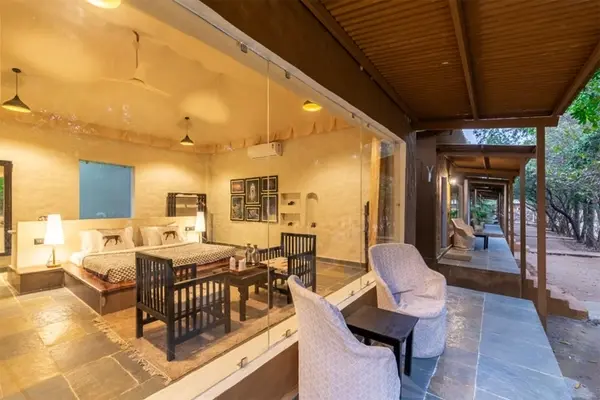
Ranthambore Tiger Machan sits 1.5 kilometres from the national park on Ranthambhore Road. In-house naturalists contextualise what you see on safari in relation to the fort's history and the landscape's past. Maharaja Tents, AC Machan Tents, and cottages are available alongside pre-safari briefings, folk evenings, farm visits, open-air stargazing, and authentic Rajasthani dining.
With a Booking.com Traveller Review Award 2026 and a 9.0 out of 10 rating, Ranthambore Tiger Machan is the most naturally placed resort in Ranthambore for visitors who want wildlife and heritage on the same trip.
FAQs
Q. When was Ranthambore Fort built and by whom?
Ans. Construction began in the mid-10th century (c. 944 CE) under early Chauhan rulers. Following the fall of Ajmer in 1192 CE, Govindaraja (son of Prithviraj Chauhan) established the main Chauhan dynasty branch here, expanding the fort into a major regional power.
Q. What are the Ranthambore Fort timings and ticket price?
Ans. The fort is open daily from approximately 6:00 AM to 6:00 PM with no weekly closure. Entry for Indian nationals is free (a nominal parking/maintenance fee of ₹15 to ₹25 may apply at the base). Foreign nationals pay standard ASI ticket fees (approx. ₹200–₹250). Visiting the fort does not require a national park safari permit
Q. Can I visit Ranthambore Fort without a safari booking?
Ans. Yes. The fort can be visited independently without booking a safari slot or paying national park safari fees. You can take a private vehicle, local transport, or walk up from the main gate to the fort entrance. Most travelers like to combine a Zone 1 morning safari with an independent fort tour later in the day.


Comments